Notes from the Left’s Waiting Room


There was a time when “the future” meant something specific: fully automated luxury communism, or the withering away of the state, or at least a council meeting where the people who actually cleaned the streets got to decide what happened on them. Now it mostly means an app that nudges us to drink more water while a venture capitalist explains that this is “democratising wellness.” The right does have a future, of sorts: a fever‑dream return to an imaginary 1950s, with cleaner pavements, stricter hierarchies and people who knew their place. The liberal centre has a future; it’s the same spreadsheet, only greener round the edges.
And people like me – the broad, critical, tech‑sceptical left – too often have a mood. My mood, if I am honest, is a mixture of exhaustion and superiority. I know why the smart city is a surveillance architecture; I can talk for hours about data extraction, the platform economy and how “innovation” is just industrial policy with a TED Talk. I can rattle off the scandals, from Cambridge Analytica to whatever today’s flavour of AI snake oil is. I can see all the ways in which “AI” is a marketing term draped over statistical pattern‑matching and exploited clickwork. I can reach for Adorno on a deadline. I can eloquently and at length explain why the latest shiny thing is just another machine for producing precarity. In fact, that’s most of what this newsletter has been so far. What I cannot quite bring myself to do is say, with a straight face: here is what should exist instead.
Part of that is inherited trauma. The twentieth‑century Left burnt through its utopias in spectacular fashion. History did not end, but certain ways of imagining the future did. Every time someone on the left dares to sketch an actual plan – nationalise this, abolish that, build housing here, seize that patent there – you can practically hear the ghosts being invoked: we tried something like that once and look how it went. Better, then, to specialise in negation. To be the person who says no. To be the one who ruins dinner by pointing out that the “ethical” coffee chain is union‑busting and the “inclusive” tech giant has a secret deal with border enforcement. To be, in short, right.
And there is pleasure in being right. A bitter, smoky pleasure, like an over‑roasted espresso pulled by someone who hates customers. There is a craft to the kill‑shot paragraph, the scorching speech, the thread that dismantles a CEO’s manifesto line by line. I have become good at it. Which I like to show by commenting under the oddest Linkedin posts. To criticise is to be useful; to propose is to expose my neck.
Criticism also feels like the only honest stance in a world that has turned every noun into a service. When everything is so compromised – supply chains soaked in blood and diesel, pension funds propping up arms manufacturers, health systems digitally wired to leak our data to whoever pays – the idea of a “positive vision” can feel, at best, naively cute and, at worst, like complicity with the very forces I’m supposed to be fighting. Who am I to talk about “a better internet” when I know exactly how content moderation works, how labour is outsourced, how trauma is offshored to workers in countries most users couldn’t find on a map? Who am I to make a case for “good AI” when I’ve seen how many “ethics” initiatives are reputation laundries bolted onto the same old extraction machine?
And yet the nagging feeling remains: tearing things apart is not a home. I feel it in the quiet moments after a finished newsletter or article, after the last sentence lands just right and the last barb finds its mark. There’s the brief satisfaction – and then the gap. My inbox fills with grateful notes: thank you, this articulated my unease, this put into words what I’d been feeling. And my unease doubles, because all I’ve given them is a more elegant description of the trap.
The right, for all its fantasies, does at least offer doors – crooked ones, leading back into basements and oubliettes, but doors nonetheless. “Make X great again,” “take back control,” “defend Western civilisation”: awful slogans in the service of awful projects, but they are projects. There are five‑point plans, budgets, think‑tanks, and model legislation. The reactionary imagination is baroque in its detail: fortresses, walls, school curricula, birth rates, pipelines. Its future is a hallucinated past projected forward, but it is a future with furniture in it. Rooms. Occupants. A plot.
My side’s imagination, meanwhile, often stops at renovation. We will regulate, we will restrain, we will de‑platform, we will “ensure,” “safeguard,” “fence off.” We will resist, defend, mitigate, expose. All necessary verbs; without them, things get worse faster. But they are not, on their own, a horizon. A horizon is a place you walk towards, not just a line you invoke while insisting that everything currently visible is intolerable.
There are reasons for this cramped horizon that aren’t simply moral failures but structural facts. For forty years or more, the dominant story about the future has been that there is no alternative – just varying degrees of market plus safety net, growth plus “sustainability,” tech plus governance. The future became a private commodity: patents, exclusive licences, data monopolies, private‑equity climate “solutions” that all demand a return. In that landscape, it’s easier to imagine catastrophe than transformation, easier to imagine the end of liveable climate than the end of shareholder primacy. So the left, conditioned by constant defeat and the collapse of old certainties, leans into what it still has: the capacity to refuse.
But refusal cannot be my final form of adulthood. There is also the seduction of pessimism as a sign of seriousness. Say you believe in better things, and you risk sounding like a life coach. Say you want public, democratically run technology, and someone will call you utopian and remind you, with a weary patience they haven’t earned, about the bureaucracies of the past. Mock the Metaverse and your mentions fill with applause; suggest replacing it with publicly owned, worker‑governed digital spaces designed around care and play rather than capture, and people tilt their heads: interesting, but unrealistic. As though “advertising‑driven psychographic profiling at planetary scale” is the sober, sensible option.Somewhere between those reactions, a kind of self‑policing kicks in. The critic inside me taps the idealist on the shoulder and says: Better not. You’ll embarrass us. They’ll have numbers you don’t. They’ll say, “How will you pay for it?”, “What about competitiveness?”, “What about China?” and you’ll have to argue on their terrain. Stay in your lane. Write the takedown. Leave the building to someone else.
The trouble is, “someone else” keeps turning out to be the people I’m criticising. The longing to build returns in inconvenient places: in local meetings about housing and transport, when someone needs a concrete idea; in conversations with people younger than me who are tired of being told that everything is broken and doomed; in my own boredom with my repertoire. There are only so many times I can write that platform capitalism is corrosive or that AI ethics panels are fig leaves before the sentences start to taste like chewing gum that’s lost its flavour. So what would it mean, for me, to risk something as unfashionable as a left concept of the future – especially around technology? It doesn’t have to mean drawing up a single blueprint and declaring it The Plan. In fact, it cannot mean that, unless we’re very keen to repeat the worst mistakes of the twentieth century. A more modest, and at the same time more radical, move might be to reclaim planning itself as a public, contested, even joyful activity. Instead of treating the future as a tech demo narrated by a billionaire, treat it as a public work‑in‑progress in which every decision about infrastructure, code, logistics and care is political and therefore up for debate.
A left future worth the name doesn’t need to promise perfection; it needs to promise more control over the conditions of life than we have now. That control will be messy, uneven, often boring. It will look less like a manifesto and more like budgets, timetables, contracts and by‑laws. For me, that also requires a different tone. It doesn’t mean dropping criticism – if anything, it means sharpening it. But it does mean trying to couple every “no” with at least the outline of a “yes.” No, this data grab is unacceptable; yes, here is a model of community data stewardship that protects people and still allows research. No, these working conditions are intolerable; yes, here are concrete demands and a picture of a workplace that doesn’t feel like a slow‑motion health hazard. No, this AI deployment in welfare or policing is illegitimate; yes, here are non‑automated ways to provide support or ensure safety that don’t treat people as datapoints.
The fear, of course, is that as soon as I start sketching the “yes,” I’ll be told it isn’t good enough. And it won’t be. It will be partial, flawed, open to abuse, subject to capture. But so is everything that actually exists. The right understands this and doesn’t let it stop them: their projects are ugly, but they’re building them. Roads. Walls. Laws. Media systems. My own allergy to imperfection can be a moral stance, but it’s also a very convenient excuse to stay in the safer territory of critique. There is another way to think: treat futures like drafts. Not sacred visions, but working documents. Try things. Worker‑owned platforms. Public clouds. Municipal broadband. Stronger unions in the tech sector itself. Collective control over training data. Libraries that host local digital services. Ecological planning that treats energy use in data centres as a public issue, not a private optimisation exercise. None of these is a silver bullet; each is a brick. Enough bricks, placed with care, begin to look like a building.
To move that way means accepting that my job description is changing. It’s no longer enough to be the person who can smell bullshit from three rooms away. That remains essential, but it cannot be the destination. If I’m serious about yearning for something to build, I have to do something deeply unfashionable in an age of hot takes: learn to collaborate. With organisers, with engineers, with bureaucrats, with the person who knows how to fix the server and the one who knows how to run a meeting without it descending into chaos. The future will not be written by a single, flawless essay; it will be negotiated into being by people who sometimes mispronounce Foucault but can write a grant application.
This isn’t a vow to “be more optimistic.” Optimism, as usually sold, is just denial with better lighting. It’s a vow to treat imagination as a muscle that atrophies without use. If I spend years training it only for demolition, I will forget how to construct. That is how I want my work to read: not as a series of pre‑written obituaries, but as a set of invitations. The right is busy manufacturing a future out of its nightmares. The tech industry is busy renting out its version of the future by the month, with a steep early‑termination fee. If I want to be more than an usher at the funeral of possibility, I will have to do something riskier than critique: I will have to pick up a hammer.
In January, this newsletter will turn one year old. Maybe that’s a good time to start being productive.

Here are a few things I’ve been reading lately — not all of which I’d sign my name to, but each provocative enough to merit the time it takes to disagree with them.
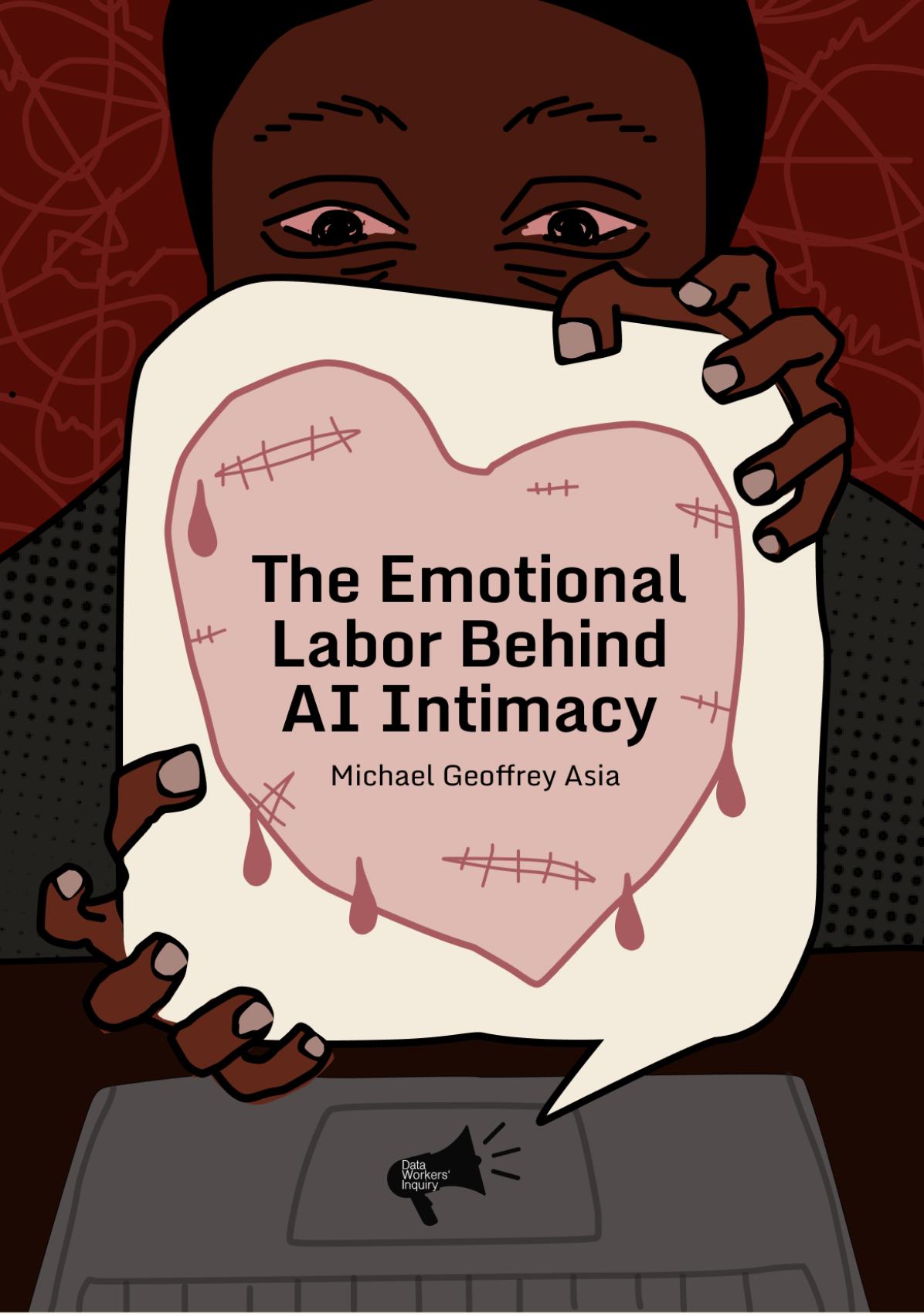
Imagine sharing your private fantasies with what you believe is a bot that cannot judge or remember. Just that, on the other side, is a man in a one-room home in Nairobi, pretending to be an AI companion. That man is Michael, and this is his story.
•
 Alex Struwe
What if our idea of reading is already hollowed out? Here's a piece that argues that when reading is reduced to fast knowledge intake and self‑optimisation, AI can do it better than we can. In the process of us accepting this, we abandon the slow, uncomfortable work of self‑reflection and criticism, and sleepwalk into a culture of certainty, affirmation and soft authoritarianism dressed up as convenience and “content”.
•
 Johana Bhuiyan
"In early September, a woman, nine months pregnant, walked into the emergency obstetrics unit of a Colorado hospital. Though the labor and delivery staff caring for her expected her to have a smooth delivery, her case presented complications almost immediately. The woman, who was born in central Asia, checked into the hospital with a smart watch on her wrist, said two hospital workers who cared for her during her labor, and whom the Guardian is not identifying to avoid exposing their hospital or patients to retaliation. The device was not an ordinary smart watch made by Apple or Samsung, but a special type that US Immigration and Custom Enforcement (ICE) had mandated the woman wear at all times, allowing the agency to track her. The device was beeping when she entered the hospital, indicating she needed to charge it, and she worried that if the battery died, ICE agents would think she was trying to disappear, the hospital workers recalled."
You've reached the end. Thank you for reading.