The Nervous System of Anthony Bourdain

Anthony Bourdain once asked, on air, whether it would displease anyone if he walked over and punched Henry Kissinger in the face. What initially seemed like a harmless joke quickly revealed its darker side—the threat was all too real. Bourdain, arguably one of the world’s most well-travelled people, had “seen his work” – the craters in Cambodia, the fallout of clever men in safe rooms signing other people’s death warrants. That, right there, is the starting point: a man whose passport stamps are not lifestyle content, but a charge sheet. A man whose appetite for the world produces not TED Talk uplift or Linkedin garbage, but a simple, furious conclusion: Kissinger should not be allowed to eat in peace in New York restaurants.
We’ll get back to Anthony Bourdain in a bit. He is, after all, the main character of today’s newsletter. But first, let me take the long way around.
Hate is a useful emotion, sharp as a kitchen knife, and mine for Artificial Intelligence has forced a reckoning. I have questions about the slippery definitions of intelligence, humanity, and the real. If I’m going to loathe AI, I at least owe it the courtesy of a clear charge sheet: What separates a human mind from the cold calculus of code? In an era where LLMs assault my craft—writing—I’ve been compelled to interrogate what makes a sentence sing, what draws the eye and grips the gut. It’s not efficiency or volume; it’s the raw pulse, the human messiness. So, then, to get closer to this question, I asked myself: What are real-life examples of the opposite of AI?
Consider the antithesis: Anthony Bourdain, whose every word and wander felt like a middle finger to the scripted life. He was the exact opposite of AI’s sterile precision, a man who dove headfirst into the world’s underbelly, tasting the blood and spice of real experience. No motivational platitudes from him; his wisdom emerged from the scars of kitchens and streets, like his blunt creed: “Don’t lie about it. You made a mistake. Admit it and move on. Just don’t do it again. Ever”.
Bourdain’s style—a stew of expletives, sarcasm, and unflinching honesty—mirrored the chaos he chronicled, treating words like ingredients: simple, flavourful, no fuss.
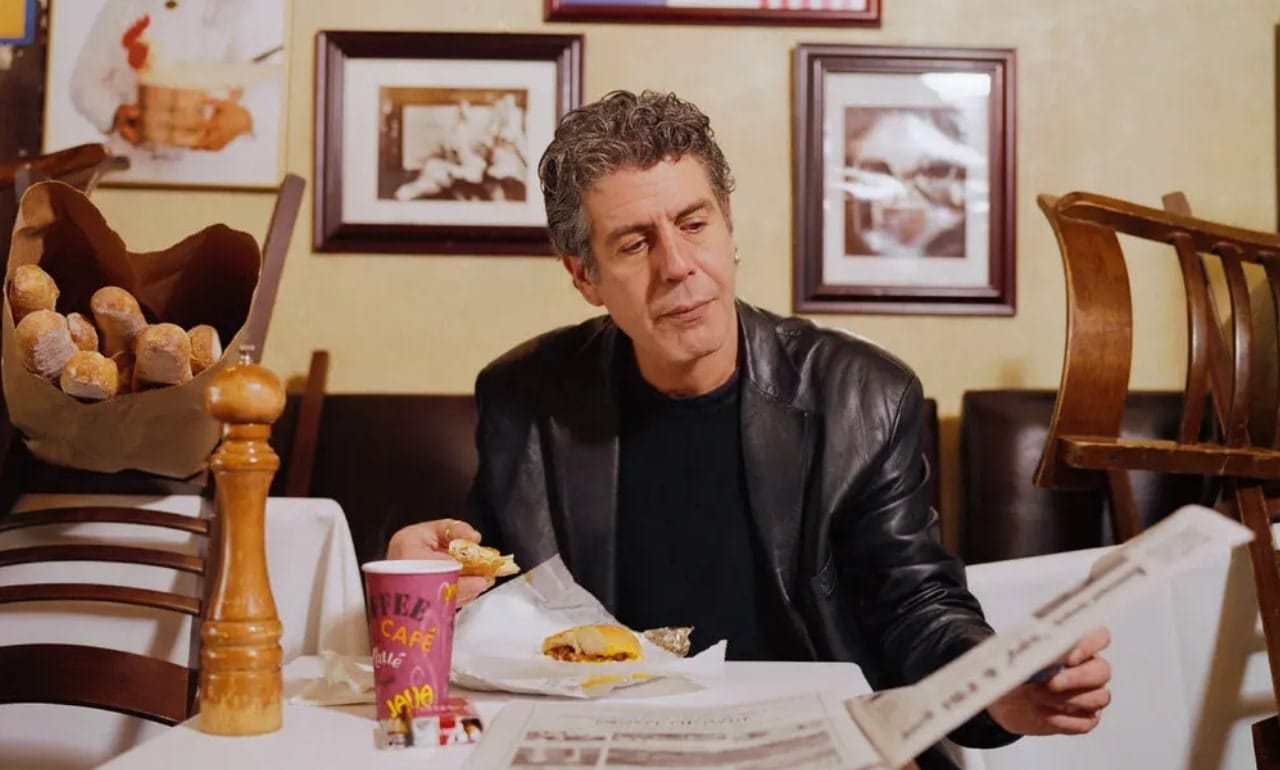
AI, by contrast, smooths edges into blandness, erasing the doubt and nuance he championed: “Life is complicated. It’s filled with nuance. It’s unsatisfying… If I believe in anything, it is doubt”. Where LLMs predict and polish, Bourdain provoked, his curiosity a punk rebellion against the proper, inclusive ethos that bridged cultures through shared meals and unvarnished tales.
Sure, AI knows about Cambodia. It can list tonnage of bombs, casualty estimates, peace accords, and footnote it all in milliseconds. It can generate a perfectly “balanced” paragraph about Kissinger that would not trouble your relatives at Christmas dinner. But only a human being who has stood in a Cambodian field with people who can still point to where their relatives disappeared decides that the appropriate moral response is. As Bourdain said about Kissinger in his 2001 book, A Cook’s Tour:
“Once you’ve been to Cambodia, you’ll never stop wanting to beat Henry Kissinger to death with your bare hands. You will never again be able to open a newspaper and read about that treacherous, prevaricating, murderous scumbag sitting down for a nice chat with Charlie Rose or attending some black-tie affair for a new glossy magazine without choking. Witness what Henry did in Cambodia – the fruits of his genius for statesmanship – and you will never understand why he’s not sitting in the dock at The Hague next to Milošević.”
That is not a policy position. That is a nervous system statement. It’s the body, not the model. AI optimises for plausible text. Bourdain optimised for being able to live with himself.
And this is where my hatred of AI has backed me into a corner and made me look in the mirror. If the machine can write something that looks, at first glance, like what I do for a living, then I have to decide what I actually do. If intelligence is no longer the ability to arrange words into coherent, even stylish, paragraphs, then what is it? Human intelligence, the kind I still care about, is not the capacity to generate language, but to incur risk with it. To put your name, your face, your travel history, your sense of justice on the line and say: this person is a war criminal; this situation is obscene; this cliché is a lie. AI doesn’t incur risk; it puzzles over distributions. It doesn’t hate Kissinger. It doesn’t love Cambodia. It doesn’t lie awake replaying a conversation with a survivor and thinking, “If I ever shake that man’s hand, I’ve betrayed them.”
A few weeks ago, in Hamburg’s Elbphilharmonie, watching Zaho de Sagazan, I had that unnerving feeling that “alive” wasn’t a big enough word. There was this sense of surplus, of emotional voltage spilling over the circuitry our culture normally provides. Two hours in which every note declared: this is a human being burning fuel in real time. The performance wasn’t “authentic” in the Instagram sense – pre-curated vulnerability with good lighting – but in the older, more dangerous sense: something might crack here. Something might go wrong. It was transcendental only because it was first completely, insistently mortal. An AI could mimic her timbre, approximate her lyrics, stitch her gestures into a convincing composite, but it could never produce the knowledge that this person will one day die and never sing again. That knowledge is what you felt in the room. (By all means, watch the ARTE recording of her set, but understand it for what it is: the postcard, not the storm; the real weather passed through the Elbphilharmonie and is gone for good.)
Bourdain traded in exactly that surplus. He was, in many ways, a terrible candidate for the age of personal brands: recovering addict, chain-smoker, self-sabotaging line cook turned accidental celebrity. But he understood that television, like politics and social media, had become one long motivational speech. Everyone these days is auditioning for the role of spiritual tour guide. Take Matthew McConaughey, the most cartoonish version: a man so in love with the sound of his own drawl he seems to believe cadence is content. You could feed his words into an AI and get the same results out: self-help mulch, optimised for applause.
Bourdain, by contrast, never pretended to be wiser than the cook sweating next to him or the taxi driver guiding him to the best noodles in town. His prose was sharp, funny, occasionally cruel. Still, it always came with a receipt stapled to it: the hangovers, the service industry trauma, the failed relationships, the years of being an arrogant prick before he learned to shut up and listen. He didn’t posture as “the good white guy” who parachutes into the Global South and blesses it with his understanding. He used his platform to get out of the way on camera, to let the people making the food talk, and then used his voice to aim a punch – rhetorical, moral – at the likes of Kissinger. That two-step is precisely what machines can’t do: yield the stage and then come back with a verdict that costs you something.
All of this loops back to what I’m trying to do here, in this newsletter, with my own ambivalence and rage about AI. If this is going to be more than a content farm in ethical drag, the lines have to be raw enough that I’m at least a little afraid of them after I hit publish. Christopher Hitchens helped me find the pleasure in a well-aimed polemic, the joy of dismantling cant with a single, clean sentence. Bourdain shows us how to keep the seams visible, to admit the doubt, the disgust, the tenderness – to say that certain things, and certain people, deserve our contempt, and that saying so is not “unbalanced” but finally honest. In the shadow of systems designed to predict, smooth and neuter, the only real option is to write like a man who’s seen the craters and is still, years later, ready to swing.

Here are some articles I've read over the past week.
 Felix Schmale
"In order to generate an image of the present or even the future, generative AI relies on images and data from the past. This makes it structurally conservative, even nostalgic. (...) The supposed technology of the future often serves less to visualize possible futures than to produce alternative pasts: images in the subjunctive, as Alexander Kluge called them, images of what could have been."
 Benjamin Riley
"Cutting-edge research shows language is not the same as intelligence. The entire AI bubble is built on ignoring it."
 Frank Landymore
"LLMs are simply tools that emulate the communicative function of language."
Remember when I mentioned Paulina Borsook not too long ago? Well, hold onto your hats because The New York Times has just unleashed a profile on her! This could spell good news for her book—fingers crossed that a savvy publishing house jumps on the chance to reprint it.
You've reached the end. Thank you for reading!